Thursday, September 29, 2011

A Warm Breeze from the Coast

It's been a while since my last motorcycle trip (Ramadan isn't ideal for traveling and my eldest daughter was visiting from school), so I decided it was time to hit the road and visit a friend down in Ubud to chat and pick up an antique keris that I bought many years ago. My friend kindly offered to have it cleaned for me, and now that it was done I had a great excuse to visit Ubud.


I've been dropping in to Ubud for short visits since I first arrived in Indonesia back in 1989. My trips back in the early days were mainly to look for Balinese art. I'd stay a night or two in a local homestay, get what I wanted and then head back home. What I mostly remember about Ubud back then was how early the village closed down. The streets would be dark and deserted by 10 pm. Years later, I started visiting Ubud with friends to stay a night or two, hear some music, do a little shopping and spend a lot of time in one or another of the bars or clubs. Now, I mostly visit Ubud to visit my American friend and discuss expat life, local and world politics, kids and school and anything else that pops up during the three or four hours that we spend together.


After visiting my buddy, I return to the inexpensive homestay that I've been using as my base in Ubud for the past 22 years. The homestay offers basic rooms with two beds, a fan, an outdoor bathroom with cold water, and the traditional Balinese double doors. No frills, although they do have two new rooms with hot water. What I love about the place is that the folks are friendly but not intrusive. We always have a short chat when I arrive, and then they just go back to their daily household routines. They do provide plenty of hot water along with coffee and tea, and the breakfast is quite good: a large fruit salad along with either an egg or a banana pancake. While the price has gone up over the years, the 100,000 rupiah they charge now is reasonable and fits in my traveling budget of 150,000 a night for a room.

So after returning from my visit, I have a shower and nap, and then wander around a bit. This usually includes buying a book and then having dinner at one of Ubud's many restaurants. While Ubud is one of the top destinations for visitors to Bali because of the cultural attractions (dances, music, art) and the gorgeous countryside, it has limited interest for me because I've been to the ceremonies and dances. I do enjoy watching the tourists, however. We don't get many in Kampung Bugis, so they're some akin to a birdwatcher catching sight of a rare species.

While I was driving down to Ubud from Kintamani, I passed three groups of tourists doing one of the bike rides that go down from Kintamani to Ubud, and then later several groups getting ready to do one of the rafting trips on the Ayung River. There are a number of companies that offer biking and rafting like Bali Adventure Tours and Sobek. So, there were plenty of tourists around Ubud to keep me amused.

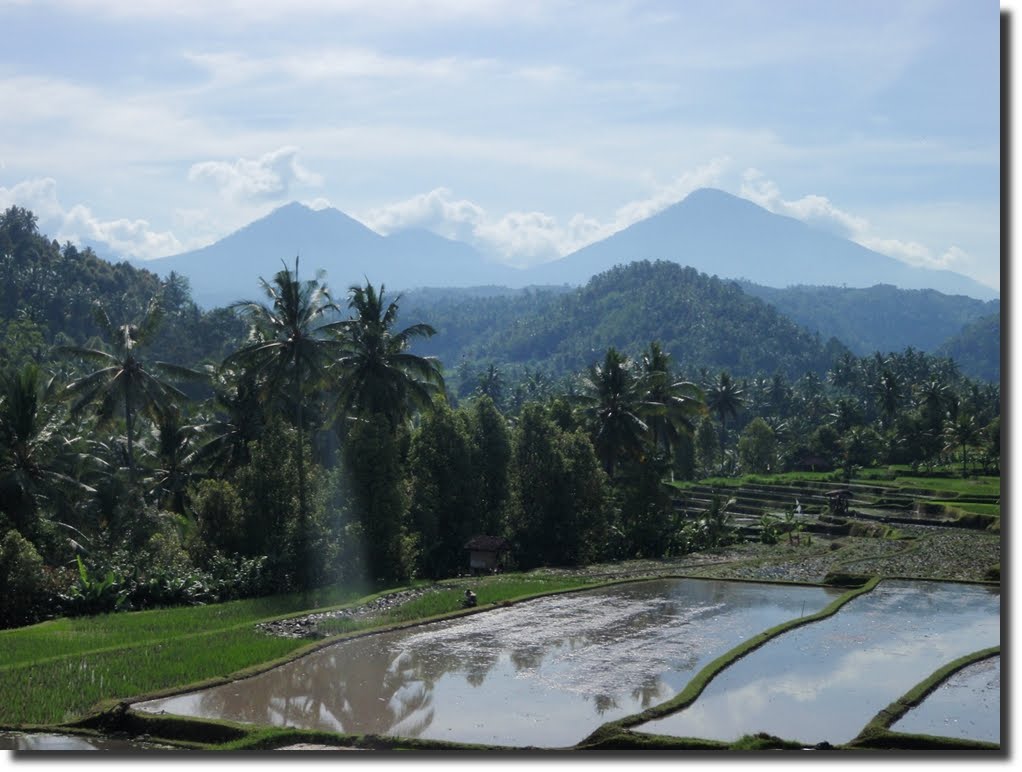
Coming back to Kampung Bugis from Ubud, I drove up to Kintamani through a soft morning rain. I love getting out on the road early with the markets full, kids on their way to school and the smell of wood fires burning in the villages. By the time I hit Kintamani, the fog was so thick that visibility was down to 3 meters and a stiff wind was blowing up from the west. Indonesians on motorbikes tend to dress like I used to during the cold Chicago winters when I was a kid: gloves, scarves, heavy jackets. I wore a t-shirt, and I was freezing. My hands were numb from the cold and the vise-like grip that I had on the motorcycle because of the hazardous driving conditions. As I moved down the mountain, the fog cleared up and a dazzling blue sky appeared overhead. A warm breeze from the coast let me know that I was getting close to home. North Bali's brilliant coast never looked better.

Now it's time to figure out where to go on my next trip around Bali.

Tuesday, August 09, 2011

Road Trip to Sanur

I haven't been out on the road much lately, mostly because of a few health issues. But, an old friend returned from his new teaching job in China, and I wanted to get a chance to sit down and catch up with him. The first plan was to stay in one of the inexpensive hotels in Kuta where I usually sleep when I need to do something down in the south that will take long enough to warrant not doing a round-trip in one day. But, this being the tourist season, all the places where I usually stay were full. Not surprising as the Kuta area becomes Little Australia at this time of the year.


So, the next plan was to sleep on the floor at my friend's house in Jimbaran. I took off on a lovely morning last week and left early enough that I missed most of the crazy traffic of tourist buses that is common in August in the mountains just south of Singaraja. The drive was very enjoyable until I hit the Denpasar area and ran into major traffic. I was on the Bypass and by the time that I reached Sanur, I was hot, sore and choking on exhaust fumes. I stopped off at a restaurant that I used to frequent years ago to have a cold beer and stretch my muscles some. After a few beers, I asked about the price of a room and was pleasantly surprised at the price which was right in my range of 100,000 – 150,000 per night. The room was basic but had a comfortable bed, a fan that worked and a clean bathroom. Added to that, the hotel had a restaurant with good food and a location that's only a few minutes walk to the beach. I thought that it might be a good idea to grab a room in Sanur, rather than cramping my friend and his family in their small house. As things turned out the room was fine, the food that my friend and I had for dinner was excellent, and I had a pleasant afternoon walk down along the beach. We had a few drinks as well, of course.

So, I've found another nice place to stay down south, plus it's not in the Kuta area which is almost always a good thing. Occasionally, I like staying in the Kuta area if I really need to do some shopping there, but Sanur is much less hectic and pleasant overall. During my stroll down along the beach, no one pestered me for transport, a room, a girl, a boy, some drugs. No one even tried to get me to have something to eat or drink in one of the many restaurants along the beach. I'd forgotten that there are some places down south that are quiet and relaxed. Next time I'm looking for a place to base myself while I do business in the south, I'll pick Sanur over Kuta.

Tuesday, June 14, 2011

Fifth in a Series on Moving Overseas: Malaysia

Southeast Asia is a popular destination for foreigners who want to move overseas whether it be for retirement or just a change of life. It would be interesting to see the statistics on the number of Americans who are leaving the States for overseas destinations as the economy of the US seems stuck in the doldrums. Life in Southeast Asia can certainly be less expensive than life in the States, and the warm weather is attractive for those of us getting on in years who don't want to deal with cold weather and snow. I've already written extensively about life here in Indonesia, and I've touched on the Philippines and Thailand as two popular destinations for new expats. But, there is another Southeast Asian country that is actively seeking foreigners who want to relocate to this part of the world: Malaysia.

Malaysia's government set up the Malaysia My Second Home program (MM2H) for foreigners who want to move to the country on a long term basis. Some of the features of the program are: a ten-year multiple-entry visa, tax-free import privileges, the ability to purchase a home, the ability to invest in and own a business, no taxes on income earned outside the country, and a clear set of procedures for entry into the program.


MM2H has two sets of financial requirements: one for people under 50, and one for people over 50. The under-50 requirements are a bit stiff in regards to finances – it's required to have a minimum of RM500,000 and a monthly offshore income of RM10,000; that's around USD165,000 and USD3,333. So, foreigners who want to retire early need to have some significant financial resources available. For the over-50 crowd, things are a bit more reasonable. We need to have RM350,000 in assets and a monthly income from a government approved pension of RM10,000, or a fixed deposit account in Malaysia of RM150,000. While it is possible to purchase a house, the price of the house has to be at least RM500,000. So, while the 10-year visa and tax-free status looks great, the financial requirements may be above the resources of many of us.

Reading a few blogs about life for expats in Malaysia, their experiences seem to be very similar in many respects to that of life for expats in Indonesia. The positives about moving to Malaysia include a low cost of living, an infrastructure that is one of the most developed in Southeast Asia, a stable political system, a low crime rate, the multiculturalism of the country and an excellent location for traveling around the region.

So, as potential expats look around for places in SE Asia to retire to, Malaysia appears to offer some attractive benefits but at a cost. At this stage, Indonesia's financial requirements for long-term residency are lower than Malaysia's. For someone like me with a retirement income below the Malaysian requirements, I'd say that retiring in Indonesia is the more attractive option.

Friday, May 20, 2011

My 5 Favorite Cities for Walking Around

Walking is the best way to explore all the nuances and nooks and crannies that define a city's ethos. These days so many of us stick to a car, motorcycle or public transportation; this is especially true in the tropics where heat and humidity can discourage all but the most diehard walkers. I just finished reading Orhan Pamuk's novel, The Museum of Innocence, and I was struck by his use of the city as another character in the story that he tells. When I finished the novel, I was overwhelmed by the desire to hop on a plane to Istanbul and wander through the city. I was reflecting on this while sitting on the roof late yesterday afternoon watching the sun set as I usually do on nice days here in Bali. Gazing over the city of Singaraja, I was struck by how much of the city I've yet to walk through despite living here for over 20 years. That got me to thinking about my favorite cities to walk in as I love walking through cities. Here are my five favorite cities.

Chicago

OK, I was born in Chicago so I'm somewhat biased, but I spent a lot of my youth wandering the city, especially the area that runs from downtown up through the Near North Side and into Lincoln Park. I did a few searches to see if I could come across some photos of the area from back in those times and found, to my surprise, that there are all these mini-neighborhoods now that weren't there 40 years ago. Well, regardless, Chicago is a great walking city. A walk from downtown going north takes the walker past a variety of restaurants, bars and cafes, which offer weary walkers a chance to rest and refresh themselves. Some highlights include the nightlife area, Rush Street, Old Town with its quaint buildings dating back to before the great Chicago Fire, the Gold Coast featuring mansions dating back to the late 19th Century, the lakefront and, of course, Lincoln Park Zoo.

San Francisco
OK, another home town. I moved to San Francisco after I left Chicago, and The City by the Bay is one great place to walk through. Again, I'm a bit biased; I fell in love with a beautiful young woman on one of my walks through the city. The Embarcadero is a great place to start. Going north, I'd follow the Embarcadero up to Fisherman's Wharf and stop for a snack at one of the many restaurants and cafes there. After a break, I'd make my way down to North Beach with a visit to City Lights Bookstore the old home of the Beats with a quick stop at Caffe Trieste for a cool beer or two. Refreshed once again, I head for Chinatown and stop for an early dinner and end up the walk down at the Powell Street Bart station to head back to Berkeley. This is just one of the many possible walks around the city. I've left out Nob Hill, Russian Hill, the Haight and Golden Gate Park. I don't know that there is anyplace in the world with as many great walks as San Francisco.


Singapore

Time to get out of the historical mode and into the present. Now we get to the favorite places that I've actually walked through in the past few years. Singapore can be hot and sticky for visitors from outside Asia, but the city is easily walkable with loads of fancy international restaurants and neighborhood haunts to stop in for a snack, meal or drink or two. Orchard Road might seem like one mall after the next, but the streets still have some great treats like local buskers playing traditional instruments, high school dance groups performing for pun, or just watching the tourists and locals get on with their business. Count the number of people that pass by that are talking on a cell phone while walking. In a twenty-minute period last year, 75% of the people that passed me were talking on their phones. Get out of the mass of shoppers and travel up to Chinatown for a look at what's left of old Singapore. There are still many traditional old shophouses and local restaurants. Take a look in a Chinese apothecary and see some of the fascinating traditional medicines that they have for sale. I love wandering around the Kreta Ayer Road area. Sometimes I stay at the cool little boutique hotel, 1929, and sometimes I stay across the street at the Keong Saik, not quite as cool but a little less expensive. One of the best places to eat in Singapore is this little outdoor place across the street, Kim Hock Seng. They have great seafood and back when I still ate pork, they had some delicious pork dishes. This hole in the wall is often crowded with local workers and then suddenly a Mercedes will pull up and some wealthy folks will pile out for lunch. The Sri Layan Sithi Vinayagar Temple is right here as well. While, Chinatown is my favorite place to walk in Singapore, there are just so many great areas that an enthusiastic walker could spend weeks just exploring the city.

Bangkok
Bangkok is not usually thought of as a great place for walking, but I love strolling through the farang ghetto on Sukhumvit. I've been staying for years on either Soi 22 or Soi 23 when I visit Bangkok, and they are excellent starting points for a walk around the Sukhumvit area. Sukhumvit just past Asoke has one of my favorite bookstores, Asia Books. This small multi-story bookstore is filled with books from travel to history to children's books. The staff are helpful and it's possible to spend an hour or more browsing. And when I have a need for something from McDonald’s, it's right down the street from Asia Books. One of my favorite Robinson's stores is right there as well. So, I can get a lot of shopping done on these walking trips around Sukhumvit, and I plan my walking trips around what I need to do in terms of shopping. Back across a very crowded Asoke and over on Soi 23, is the famous, or infamous, Soi Cowboy. This nightlife street is fascinating to observe during the daytime when nothing much is going on. I like sitting in one of my favorite restaurants in Bangkok, Old Dutch, which is just at the Soi 23 entrance to Soi Cowboy, and watch the daytime activities. Then back to the Tai Pan Hotel just down the street to drop off any shopping and then out again to wander around the leafy, quiet backstreets in the area. My dentist in Bangkok, Bangkok Smile Dental Clinic, is in the area as well so I can always fit a visit to the dentist during one of my walks. And there's a number of little bars around if I feel in need of some refreshment. This is just one of my walks in the immediate neighborhood of my hotel. Other sections of Sukhumvit offers much more including some cool antique shops, mom and pop grocery stores and the Emporium mall if I feel really hot and need to get off the street for a while and cool down. I love the Sukhumvit area.

Singaraja
OK, my third hometown on the list. Singaraja was once the capital of Bali back during the colonial period. For tourists visiting Bali who only know the Kuta-Legian-Seminyak strip of tourist madness or the increasingly crowded and commercial Ubud, Singaraja is something completely different. Owing to the history of the area, Singaraja is one of the more multicultural areas of Bali. This is where cruise ships used to dock and ships from around the country used to dock at the old harbor, which just happens to be a few hundred meters from where I live. Our neighborhood, Kampung Bugis, is a poor little neighborhood, but we get a lot of walking visitors who come over from the harbor to view a fishing neighborhood. Just south of us is the main shopping area of Singaraja, Jalan Diponegoro. Nothing fancy here, no Starbucks or Pizza Hut or even a MacDonald's. Just a collection of small general stores, a few bookstores selling mostly textbooks, a handful of stores selling televisions and other electronics, and a couple of small hole-in-the-wall eating establishments. Nothing fancy here, just a working city along the north coast of Bali. The center of the city has wide streets with remnants of colonial architecture that reflect the hundred years of Dutch presence, as Buleleng (the regency where Singaraja is) was colonized much earlier than the south of Bali. It's possible to wander the streets of Singaraja without ever being hassled for transport or a hotel or a girl. Far different from the tourist areas of Bali, including Lovina, the tourist and expat ghetto to the west of Singaraja. I still have a lot of exploring to do here, but I'm looking forward to it.

Saturday, April 23, 2011

My Three Favorite Drives Around Bali

Generally, I hate driving in Bali. I actually love driving in general, but here – no, just too crazy and too dangerous. It just drives me nuts when tourists get into some mystical explanation of how traffic works here and how everything goes fine. Well, in fact, it doesn't go fine. I've known nine people that died here in accidents over the past 21 years. So, beware when driving around the island. Wear a helmet, long pants, shoes and a shirt, not a singlet.

But, I do love getting out on the motorcycle and driving around the island once every month or two months. Outside of the cities, the roads are relatively free of traffic, and it's possible to really enjoy driving around the island and appreciate the beauty of Bali outside of the cities. I begin my drives from downtown Singaraja, but these drives can be taken from the south up to the north for folks who want to visit the Singaraja area.


Singaraja to Ubud via Kintamani
I drive out from Singaraja on the main road to the Kintamani turnoff in the village of Kubutambahan. Driving out of the city requires some concentration because the traffic gets intense in the morning, especially around the start of school. I usually leave around 9 am in order to miss most of the crazy early morning drivers. Once I'm on the road up through the hills to Kintamani and Mount Batur, I can relax and enjoy the incredible views of the ocean to the east. There's minimal traffic on this road, which allows me to get into a driving zone. Just past Kintamani, before reaching the temple, there's a turn-off down to Ubud. Fortunately for me, since I have terrible problems with directions, there's now a sign for the turn-off. The road down from Kintamani to Ubud was, once upon a time, one of the worst roads in Bali; it was filled with huge potholes and loose gravel. I actually lost control of the bike once because of the road conditions. Now, however, the road is wonderfully paved with lovely views of the orange groves alongside the road. It's a straight drive down to Ubud with a right turn at the statue.

Singaraja to Candidasa on the east coast road
I used this road many times during my six years in Sumbawa when I was going back and forth between Sumbawa and Bali. The east coast road features landscapes much different than the rest of the island. The north coast section of the road is lined with coconut groves, farther south the landscape becomes drier until you reach the area around Tulamben which is very dry and still shows the signs of the eruption of Mount Agung in 1963. This drive takes you past the small tourist area of Air Sanih and then Tulamben, Tirtagangga and finally Candidasa. Along the way are a number of hotels and homestays for folks that want to spend a night or two exploring the area. For me, it's just a lovely drive past picturesque villages with some incredible rice paddies once you reach the southern part of the road.

Singaraja through Pupan and down south
This road is on the west side of the island. I traveled this road the first time that I came to Bali. That time I was on a bus going from Denpasar to Lovina. What an

incredible introduction to the Balinese countryside it was. Now, I just drive west from Singaraja just up to Seririt and then travel south through small villages up into the hills and then down through glistening rice paddies. When I've had enough of the magic of Bali, I turn around and head back home. This is another road with a minimal amount of traffic and views that you want to photograph and send back to your friends and family at home to let them know just what Bali is outside of the tourist zoo of Kuta-Legian-Seminyak.

Wednesday, March 02, 2011

Lombok: An Alternative to Bali

The island of Lombok, situated due east of the fabled tropical resort island of Bali, is developing its potential as an attractive multicultural alternative to Bali for the backpacking set as well as for more upscale tourists. Government tourism officials and local business people are actively working together to promote Lombok's vast potential for the millions of tourists that visit Indonesia annually. Lombok's promotions highlight its natural beauty, friendly population and relaxed atmosphere.

Geography
Lombok is a small island that is located between Bali and Sumbawa in Indonesia. It has a population of approximately 3.2 million people and is small enough that it can be crossed east-to-west in a car or on a motorbike in about two hours. The western side of the island tends to receive more rain than the drier eastern side of the island. The active volcano Mt. Rinjani is on the east coast. The southern coast is excellent for surfing. About 85% of Lombok's population are ethnic Sasaks who practice Islam. Balinese Hindus make up about 10% of the population with the remainder of the population coming from other islands usually to look for work in the tourist industry.

Attractions
Lombok has a predominately agriculturally-based economy, but the tourist industry is rapidly developing. Lombok offers a wide variety of activities for visitors including snorkeling, diving, surfing, mountain trekking, and learning about the local cultures.

While Bali has a number of excellent surfing spots, they are usually quite crowded. Lombok has some ideal spots, such as Desert Point, where surfers can enjoys great waves without the crowds found in Bali's favorite surfing spots. The Gili islands off the north coast are a popular diving spot because of their crystal blue waters and abundant sea life where divers can view reef sharks, sea turtles, octopus, manta rays and a large variety of exotic tropical fish. Gili Trawangan, the largest of the three Gili islands, has a number of PADI certified instructors available to teach new divers.

For the visitors who prefer land action, hiking to the top of Mt. Rinjani is a challenging activity. Rinjani is the third highest mountain in Indonesia at 3726 meters. While some visitors like the attempt to trek to the top of Rinjani without the assistance of guides or porters, the difficulty of the terrain makes this unwise. For visitors who prefer a more laid-back vacation, Lombok has a number of star-rated hotels for relaxing by the pool or on the beach with a tropical cocktail while they enjoy Indonesia's beautiful sunsets.

Places to Stay
Lombok has two main tourist areas: Sengiggi on the north coast and Kuta on the south coast. Sengiggi, which is only a short drive from the airport, has the most developed facilities for visitors. This area is full of restaurants, bars, nightclubs and hotels that run from star-rated to budget-class. Kuta is set to become a major tourist destination because of the new international airport that is due to open in 2013.

Getting There
Lombok has a small international airport that mostly serves domestic flights. However, Silk Air flies to Singapore three times a week. Most visitors, however, come to Lombok from Bali. Tourists that choose this route to Lombok have several options. They can take a short 25 minute flight from the domestic terminal in Denpasar on any of six domestic airlines that provide service from Denpasar, Bali. For visitors who prefer to travel by sea an assortment of companies offer fast boat service from Bali to Lombok. Large, public ferries that accommodate both vehicles and passengers make the four-hour crossing to Lombok on an hourly basis.

Wednesday, October 21, 2009

The International Teacher 2011-2012 School Year Edition

Life overseas. Schools with first class facilities. Dedicated and polite students. A salary and lifestyle that allows you to put some money in the bank every month. An opportunity to expand your professional and personal horizons. New experiences waiting for you every day.

Does this sound like something that you want? If it is, read on.

So, how do you have a terrific time while making a great living? International teaching is your portal to a life of adventure, professional development and financial security. Jobs for teachers overseas continue to increase as new international schools open around the world. However, as opportunities increase, obtaining a job as an international teacher is more competitive than ever. Teachers need to be prepared for the competition, which is why I wrote this eBook.

The International Teacher: A Guide to Teaching Overseas, has 550 pages of up-to-date reviews of 300 international schools along with key articles on topics of fundamental importance to teachers searching for positions in international schools. In Section One of The International Teacher you will find articles on:

1. Finding the Fit
2. Writing a Cover Letter
3. Job Fairs
4. Interviews
5. Professional Development
6. The International Teacher
Section Two contains articles on International Education Organizations including:

1. The University of Northern Iowa Placement Service for Educators
2. Search Associates
3. International Schools Services
4. East Asia Regional Council of Overseas Schools
5. International Baccalaureate Organization
6. Quality Schools International
7. Oasis International Schools
8. Teacher Recruitment International
9. International Supply Teachers
10.The Council of International Schools

Section Three contains reviews of 300 international schools from five continents. Each school review contains:

1. Coverage of the school mission, facilities, curriculum, extra curricular activities, technology, professional development, employment details, and sociocultural information about the school’s location.
2. Updated links to the school website, employment information, email addresses, and more.

Why You Should Buy This Book!

This eBook is in downloadable PDF format with hyperlinks that allow you to instantly access the most recent information on 300 schools. The articles in Section One cover the most important aspects of finding an international job and allows you to be competitive in a highly competitive market. My years in international education have given me an insider’s knowledge of the international teaching market. As a retired teacher commented on a pre-publication of this book:

I wish that you had written this during my teaching years. The ease with which I was able to access information on so many schools, including ones that I have never heard of, would have made my job searches much more enjoyable and wide-ranging than they were.

A long-time international teacher commented:

An excellent resource for teachers looking for schools. Well written with witty comments and comprehensive. Cool images, which make most eBooks I have seen look positively dreary. A good buy!

For some examples of what you will find in The International Teacher go to my blog, The International Teacher. You will find reviews of schools as well as articles on teaching overseas. This eBook grew out of The International Teacher blog and covers more schools in greater detail with the most current information available. Plus, as a benefit for all purchasers of this book, you will receive next year’s update (due out in July 2012) for free. You can download two free sample chapters here and here.

About the Author

I have a Ph.D. in anthropology, and I’ve been teaching now for 33 years. My positions have ranged from preschool to university. I’ve been overseas for the past 20 years. In that time, I’ve taught just about every subject that schools offer. My first position overseas was teaching Second Grade to a group of expat students in a small mining community in Indonesia. Since then I’ve taught computers, math, anthropology, physical education, art, library, social studies, science, health, and more. I’ve been a computer coordinator at four schools, an elementary/middle school principal at two schools, and I’ve served on countless accreditation and curriculum committees as well. As a teacher and administrator, I’ve been on both sides of the job search – interviewer as well as interviewee.


Buy This Book Today! (And You Might Be Shopping in Dubai Next Year)

You can have your own copy of The International Teacher in time for the international recruiting season that starts in December. Read about the international teacher recruiting fairs that are just around the corner. You'll want to be prepared so that you can get the teaching position of your dreams.

Do you really want to keep teaching in your home country? Discover the world of overseas teaching! You could be living in a tropical paradise or one of the vibrant international cities that you've only read about.

Payment is via PayPal. The International Teacher is only $6.00 and you get all future updates for free by purchasing the second edition now.


$6.00


Best of luck in your search for an international teaching position.

Monday, September 21, 2009

Fourth in a Series on Moving Overseas: Thailand


Last week, I wrote about Stickman’s website about Thailand; this week, I’m covering another popular website about living and working in Thailand, Ajarn.com. This website has been around for a long time, and it targets English teachers in Thailand. Why another site about English teacher’s in Thailand? Well, because there are so many of them, and so many more arrive in Thailand on a regular basis.

For those of you who are new to the expat world, English teaching is one of the favorite ways to have an income while exploring the world. English teaching is particularly popular with the backpacking crowd, and the guys who are looking for relationships with Asian women. Why? That’s the next in this series; right now I want to discuss the Ajarn website.

If you want to move to Thailand, but aren’t an English teacher, this website still has a lot to offer. There are sections on the cost of living – some very detailed writing including the daily expenses for a month’s living by an expat in Thailand. There are sections on getting an apartment or a house and obtaining health insurance. There is a section on immigration and visas – very important topics for an expat. And, if you are an English teacher, or want to be one, there is the famous Ajarn job board. I found a job through there once, although in the end, I accepted a position that I found elsewhere.

For folks that want to live in Thailand, but don’t want to live in Bangkok, there is information about other regions of Thailand. And a big addition to this site is the Ajarn Writers section where you can read about the experiences of teachers in Thailand: sometimes they cover life issues of living in Thailand, other times they cover teaching issues. Some of the writers are quite good, and most of them are humorous.

So if you’re thinking of moving to Thailand, I’d recommend the Ajarn site along with the Stickman site. Once you’ve gone through both, you have a really good idea of what’s waiting for you if you move to Thailand.

Sunday, September 13, 2009

Third in a Series on Moving Overseas: Bangkok, Thailand


Thailand has always fascinated me. As a long-time expat in Asia, I’ve visited Thailand many times, although I’ve only explored the Bangkok and Chiang Mai areas of the country. Thailand has a huge expat population, many of which are employed in the English language teaching industry. But, Thailand also has a large number of Western retirees. Web sites and blogs on Thailand are numerous with varying quality.

One of the sites that I visit every week is StickmanBangkok.com. The website’s creator, Stickman, has been living and working in Bangkok since 1997. I’ve been following his website since 1999.

While one of the most popular sections on the website is Stick’s weekly column that is mostly about the “naughty nightlife” industry, there are sections on Living and Working in Bangkok, Thailand Visas, Teaching English in Bangkok, Travel in Thailand and more.

You can find specific and detailed information about food, renting an apartment, hiring household help, paying for utilities, local transportation, the Thai language, local culture, dealing with the police, the cost of living in Bangkok and a lot more. Just about anything that you need to get set up in Thailand is available here.

Stickman has been working as a teacher for many years, although he may have retired from that profession now. The section of the website on teaching English is filled with information for the new or potential teacher. If you are thinking of moving to Bangkok and securing a teaching position, you should definitely read this section.

So, if you’re thinking of moving to Thailand, part of your homework should be taking a look at Stickman’s site.

Sunday, August 30, 2009

Second in a Series on Moving Overseas: Margarita Island, Venezuela


I’ve been writing about living overseas online for the past 15 years; most of my writing has been about living in Asia – an obvious location as I live in Indonesia. But, expats and potential expats these days have the world to choose from. South and Central America is one of the popular locations for both Europeans and North Americans. Today’s site is about Margarita Island, Venezuela.

Margarita Island is a Venezuelan island in the Carribean Sea. The island is known for its white sand beaches and laid-back lifestyle. The website that I’m highlighting is written by an expat who has lived on Margarita Island for over 20 years. While the layout of the website is basic at best, the information therein is first rate. The site creator is a Canadian, Dan O’Brien, and he covers all the basics that a potential expat needs to know when making a plan for a move to paradise. Dan has a little villa, bed and breakfast, and is married to a Venezuelan lady so you would expect that he has a good grasp on the local realities. One of the pluses of this site is that Dan updates it regularly. This is an important part of a site that offers information on moving overseas.

Dan has information on weather, property ownership, foreign exchange matters, starting a business or looking for work, costs of living, language, banking, hiring household help, the political situation (something that you want to keep track of these days), medical issues, and transportation. I found the information here very helpful, and it answered most of the questions that I would have before moving to a foreign country.

One of the comments that I particularly liked was Dan’s advice: “I strongly recommend that anyone considering a permanent move to Margarita Island first rent from 6 months to a year to see if living here is to your liking.” As I’ve mentioned before when discussing Bali, I’m amazed at the number of people who just move to an island location without ever having visited. It might seem like a cool, impulsive thing to do, but island living is not for everyone, and it really is advisable to try it before you move lock, stock and barrel.

So if you’re interested in moving to an island in South America, check out Dan’s site.

Friday, August 21, 2009

Life in the Tropics: Moving Overseas

I've decided to use my blogger blogs as the place for several series of blogs that I want to write about living in the tropics. I started this series over on my blog at Wordpress, but never got beyond the first blog which I am reprinting here as the beginning of this series.

Here is the first site in my series on Moving Overseas. Living in the Philippines is a site for the expat who wants to move to the Philippines, or is considering the Philippines as a potential home.

Don A. Herrington is the creator of this site. He has been living in the Philippines since 1989, and currently resides in Cebu. Don has a Filipina wife and has been around the Philippines as long as I’ve been in Indonesia. A lot of the advice he offers is similar to the advice that I offer to potential Bali expats. Some of the topics that he covers are:

• What Do You Need to visit the Philippines?
• Why Will You Want to Live, Retire, Travel or Do Business in the Philippines?
• Why Will You Love the Philippines, the Filipinas, and Filipinos?
• Do You Want to Find Romance in the Philippines?
• Do You Want An Expat’s Life with Maids, Helpers, Drivers, Eating In and Out, Amenities?
• Lifestyles – Costs – Who is Here
• Manila and the Other Places To Live
• Maids, Domestic Helpers, Nurses, Employees Eating in and Out
• What Will You Need To be in the Philippines?
• How Can You Have A Job, Business, Investments in the Philippines?
• Join Our Discussion List
• How Can You Get More first hand information, on how to Live, Retire, Travel and Do Business in the Philippines?
• How Can This Website, Free Mailing List and I Can Help You Have A Happy Life here?
• Living in the Philippine Provinces

If you’re interested in living in the Philippines, take a look at Don’s site.

Sunday, August 09, 2009

John Hughes, Rest in Peace

John Hughes, the American film director/writer/producer died Thursday of what appeared to be a heart attack while taking a walk in New York City. He was 59 years old.

OK, so another death, another RIP post, what’s the point with Hughes?

Hughes was best known for his ‘80s movies about teen life in suburban America. While Hughes was my age (a year younger), his films hit the movie theaters just as my oldest son was entering his teen years, so I watched a number of the Hughes films, The Breakfast Club and Ferris Bueller's Day Off, with Aaron.

The films seemed at the time to resonate with my son, but they did with me as well. Hughes, who spent part of his youth in the Chicago suburbs, as did I, set most of his movies in the Chicago area. Despite not having lived in Chicago since 1979, I still have an intensely romantic image of the city that I carry with me throughout my travels in Asia. And, even though Hughes’ films mirrored the realities of ‘80s teen angst, I could see a lot of my own ‘60s angst there (not surprising as Hughes attended school at the same time as me, and in somewhat similar sociocultural settings).

As someone who has just gone through a stroke, I’m at the stage where I notice the deaths of my peers. Hughes created some memories for me, and for that I’ll remember him and his work. Looking around the internet, there are dozens of tributes to Hughes on You Tube. He obviously affected a lot of folks. Here’s one of the tributes.


Saturday, August 08, 2009

A Saturday in Sumbawa


One of the reasons that I bought a new motorcycle and brought it out to Sumbawa was so that I could get out of townsite on the weekends and do something beside sit in my little apartment watching tv, grading papers and working on the school website. Last Saturday, I went down to Rantung Beach for a swim on Saturday morning, and I had a great time. I went down today for a little swim, but the waves were really up, so I decided to take a pass.

On the way back to townsite, I decided to drive down to Tongo, but once the road got rough, I decided to come back to the apartment and finish up work on the school website. Hmm, always some work here to do.

Yesterday, two of my former students dropped by for a visit. They have been in town visiting their parents. It was great to see them and hear about what they have been up to even though I hear from them occasionally on Facebook. They are both doing great so it seems that we didn’t do too much damage to them while they were in school here. In fact, one of the girls is interested in anthropology – my main field, and the other is going to be a math major in college – my main teaching field. I love it. The girls did have a good time teasing me about my mishaps with motorbikes, forgetfulness and my sci-fi addiction.

This is week 2 of not smoking, and it still is a problem. I have this intense desire to just go out and buy a pack of cigarettes and smoke all of them. I’ve been rationalizing this by saying that I can quit smoking once I leave here and get home to Bali where I will be with Su and the kids who will be a good support group. On the other hand, I could have another stroke in the 16 more weeks that I have to work here if I start smoking again so there’s a strong motivation to not start up again. Nothing like addictive personalities.

Sunday, August 02, 2009

Back From Singapore, Life Changes and a Bit of a Rest

It’s been a long week, and I’m back from the hospital to pick up from where I left off. SOS had a few problems coordinating my leaving home, but all in all, I was very pleased with the way that they handled the whole medical evacuation.

The trip back wasn’t quite as dramatic – no doctor escort, no wheelchair, no special consideration at customs and immigration – but, it was wonderful to be back on my own power. Unfortunately, I didn’t get a chance to do any shopping in Singapore as I had just enough time to get to the airport and check-in once I was informed that I had a ticket to go home. Oh well, I’ll be back in December when I retire again, and I’m thinking of staying a few days while I get my new non-working visa.

I actually arrived back Tuesday morning, and co-taught a double biology class. By the time that I was done, I had a terrible headache and went home for the rest of the day. I came back to teach on Wednesday, but had a headache within an hour. I stopped by the clinic to see the doctor, and we discussed the headaches as well as the results of all the tests done on me in Singapore. After a long discussion, we came up with three likely causes of the headaches as it was clear from the scans and blood tests that the headaches weren’t caused by any problems with my brain: stress from trying to adapt to my new realities, a reaction to the medicines that I’m taking, or a reaction to nicotine withdrawal. The doctor told me to take the rest of the week off, and I’m on the last day of my rest period. The headaches have stopped since I’ve modified the amount of medicine that I’m taking, so that’s a good thing for me.

I’ve been thinking about the stress factor a lot during this rest period. At first I discounted it, but after a few days at home, it started to make sense to me. Lots of changes in a short period of time- turning 60, having a new granddaughter, oldest daughter turning 18, wife moving one year closer to being 50, working on my last contract, learning to live without cigarettes, and then a stroke. Yes, it does make sense to me now that I’m probably growing through a bit of stress as I enter another stage of the life cycle. Well, just going to have to deal with it.

Tomorrow back to work once again.

Monday, July 27, 2009

Singapore and Hospitals in Singapore


I’m still in Singapore and still in the hospital. The tests have all come out ok, and I’m ready to go home. I just have to wait for SOS to get me a flight out to Bali and then a flight to Sumbawa.

I’ve been restricted to the hospital for the last three days. Yesterday, I snuck out and took a quick little walk out of the hospital and down Orchard Road. I haven’t been in Singapore on a Sunday in many years. It was fascinating to watch the maids giggling and laughing in small gatherings on their day off. The street was absolutely packed. I love Singapore.

After 10 minutes, the whole trip was giving me a headache, and I decided that the last thing that I wanted to do was fall over on Orchard Road so I headed back to the hospital, had some meds for the headache and took a nap.

My eldest daughter was online with me for a while yesterday, and we had a chat about my health and the hospital. She found the hospital to be quite beautiful.

Sunday, July 26, 2009

Weirdness within Weirdness within Weirdness

I’m writing this from my hospital bed in Mt. Elizabeth’s in Singapore. From the window of my shared room, I can see a canyon of walls in this massive complex. Nothing to gaze out at and conversely nothing to gaze in. Restricted to my bed because of regulations, I pee in a cup. I’m on a fast due to testing coming up sometime this morning, and it’s been 20 hours since I’ve had a cigarette. As you can see, this is not my normal life; how did I arrive at this situation where I have assigned the right to direct my actions to others, and in this case, specifically to a group of others whom I’ve never met.

So back to the past – in this case back 33 hours ago. While watching television and talking to my children on the hand phone, I suddenly lost the feeling on the left side of my body. There was some accompanying discomfort in that I was finding it quite difficult to keep track of what the children were saying, that is make sense out of their words, and at the same time verbalize some response to them. I managed to end the conversation without alarming the children, and as I rose from my chair to get some water, I stumbled. 15 minutes later the episode passed, and except for continued numbness in my left arm, I was well enough to go to bed.

The next morning I went to work as usual, but after doing a quick search on the internet, I discovered that I may have had a tia (transient ischemic attack) – basically a mini-stroke. So after teaching my first period Social Studies class, I made an appointment at the clinic in townsite with the expat doctor. After an examination where the doc noticed that I am pretty fit for a 60 year old, he said that I should have immediately reported the episode right when it happened and that we would need to do some follow up work including CAT and MRI scans.

Now this is one of those stories that can go on interminably, so I’ll present a shortened version as I’m probably the only one who would find the long version of any interest whatsoever.

In a quite short amount of time, the doctor in Sumbawa arranged to have be flown from Sumbawa to Bali to Singapore and checked in to a hospital for a series of test in order to discover why or how, I went through my 15 minutes of confusion. I’ll leave out the hospital weirdness for another blog and focus the rest of this account on strange travel arrangements.

People that have strokes, or at least this person who had a stroke, are treated like they are made of glass. My colleagues at school wanted to drive me home and to the clinic, no riding my motorcycle. Once I made it to the clinic, I was told to stay in bed and rest, no work. Actually, that was quite helpful because I was exhausted from the night before and immediately fell asleep.

Going from the clinic in townsite to the airport/seaport in Benete, I had to lie down in the ambulance. I had a doctor from townsite accompany me from there to Bali where he handed me off to another doctor who would be accompanying me to the hospital in Singapore. There was an ambulance waiting to get me when we arrived in Bali, and it took me to the international section of the airport where I waited in the ambulance until one of the SOS people from Bali had finished arranging my ticket and checking me in. While I waited in the ambulance, I sat on the bed with the backdoor opened and watching all the tourists arriving at the airport making their way back home after a lovely vacation in Bali. Most of them looked quite happy and satisfied. Some pointedly ignored staring at the ambulance sitting in front of the departure terminal, while others stared at me sitting there (thinking by the way, who can I trick or kill to get a cigarette?) looking as bewildered as they appeared looking at me.

Eventually, I was put in a wheelchair and rolled into and through the airport with stops at various locations (ticket counter, immigration, etc) until we made it to the premier lounge where I was actually allowed to walk around by myself and pick little morsels of food and drink. It was lovely. The lounge was quite empty most of the time and very quiet. I tried the internet but it was incredibly slow. We sat around for several hours in the lounge until it was time for the flight.

I was put in a wheelchair again and wheeled through the airport to the boarding lounge where I waited with what seemed to be a full flight. Bali does not seem to be suffering from any effects of the bombings last week in Jakarta. When the boarding announcement was made, one of the Singapore Airlines staff held up a card with a wheelchair. It was quite strange to see all of these people who just minutes earlier had surged around me so as to queue up to be one of the first in the plane, quickly part like the Red Sea to let my wheelchair through.

As an long-time expat in Asia, I’m used to being something of a curiosity and someone to be stared at, but this situation was more intense than normal: a closed space, a large crowd of people who were all about to share an even smaller, more enclosed space with a stranger being pushed around in a wheelchair who looked (or so I suppose) seemingly normal – no obvious injuries or disabilities, no mask over the face, nothing that stood out as an explanation for the wheelchair.

The flight to Singapore was comfortable, but uneventful. Once we arrived in Singapore, I had to wait for a wheelchair to take me through the airport and to a waiting ambulance. Finally off to the hospital where I’ve been since Friday night.

Monday, July 20, 2009

Road Trip in Sumbawa

I’ve been back in Sumbawa for almost a week now after a beautiful month in Bali recharging my batteries for teaching and for life. The last term of the semester was one of the most trying of my professional and personal life, and, to be honest, I barely made it through the long ten weeks.

But, being back with my family, being back in Singaraja, being back in Kampung Bugis, gave me the breathing space that I needed to re-evaluate my life and my priorities. Part of the problem was reconciling myself to the end of my brief retirement and the extension of my working life for another six months.

I’ve always been one for speaking in absolutes as my therapist once pointed out many years ago, and I’ve worked on modifying that mindset. The key point here is that absolutes negate the possibility for change, and my life has been a continual unfolding of change, a crooked path of zigzags and weaves, doubling back sometimes, leaping over logical progressions, and sometimes just moving in circles. But, all that has lead me here to Sumbawa and Bali; and this is the place right now where I am happy and, at least for this time, fulfilled.

The last vacation was eventful: my 60th birthday, my eldest daughter’s 18th birthday, a new granddaughter, a new closer relationship with my youngest son, and an accepting of some new limitations brought on by the aging process as well as the realization that there are still new possibilities ahead.

I’m content – what more can I ask for?

Another Rest In Peace

Back from a two-day break to Sumbawa Besar, I've been catching up on the news reports of the latest terrorist outrage in Indonesia. There are plenty of guesses and theories as to whom is responsible. I'm not going to add mine to the bandwidth. You can go to Jakartass for some links. All I can say at this point is rest in peace to the victims and a quick resolution to the arrest of the perpetrators.

Saturday, March 28, 2009

Back in Kampung Bugis, Part IV, and Life in the Bali Sea


We’ve had guests for the past few days so I haven’t had time to blog, although I have been snorkeling. My friend, Stephen, his son, Oliver, Stephen’s friend, Ade, and Stephen’s driver, Wahid, came up from Kuta to visit for a few days. I enjoyed having them all visit; it’s been a while since I’ve had a friend visit the house. Of course, like most teachers, we talked a lot about school and education, but that’s one of the hazards of the profession – getting wrapped up in what we do.

The kids have been out of school for most of the week; we have family up from Denpasar because of the Nyepi holiday so the house has been very busy this week. Today is Kuningan so prayers from the Hindu temple just down the beach have been going on for hours now.

I let Mercedes and Rebecca drive up to Bedugal today for a treat. Lots of trepidation on my part because the roads can be so dangerous here, but I guess that I have to start to let go some as Mercedes is almost an adult – she’ll be 18 in a few months, and Rebecca will be 16 not long afterwards. Still, I’m waiting anxiously for her to call me to say that she has arrived safely in Bedugal.

I’ve been taking hundreds of photos with my Olympus underwater camera, as well as a lot of short movies. The water has been quite clear and some of the photos have come out quite clear, but I’m still working on how to use the camera. Today’s photo is of a fish that I have always called a tiger barb because I used to have Tiger Barbs when I was a kid. I’ve been going through my Collins Pocket Guide: Coral Reef Fishes, Indo-Pacific and Caribbean, to identify this fish. It seems to be an angelfish, butterfly fish or a damselfish. Based on a drawing on Page 74, I think that it is a damselfish. If anyone recognizes it, I would love to hear if I am correct in my classification.

Today’s anti-work quote is:
“Work is the refuge of people who have nothing better to do.”
—Oscar Wilde

Sunday, March 22, 2009

Back in Kampung Bugis II and Life in the Bali Sea


This is my third day back in Kampung Bugis. For those who aren’t aware of my little neighborhood, Kampung Bugis is located on the north coast of Bali in the city of Singaraja. The neighborhood hugs the shoreline just to the west of the large statue at the old harbor of Buleleng. As our house sits back only a few meters from the Bali Sea, the kids and I spend a lot of time in the water.

One of the things that I’ve always wanted was an underwater camera so that I could photo document the coral reefs in front of the house. Recently I was able to purchase the Olympus 1030 SW. My children will be able to show their children what the sea looked like decades before they were born. It would have been wonderful to have had these photos years ago before the coral started dying. There appears to be some regrowth going on, and I want to document that.

Here is the first of a series of photos on life in the sea in Kampung Bugis. The first photo is of a starfish common to this area. Marine biology is not a specialty of mine, but using the book, Indo-Pacific Coral Reef Field Guide, this starfish appears to be a Linckia laevigata. This starfish can be safely handled as I see neighborhood kids occasionally picking them up and examining them.

Starfish move quite slowly and their locomotion is the result of the water vascular system. Water is brought into the system and moved to the arms by canals. The canals are connected to the tube feet. The feet have tiny suckers, which expand and contract through hydraulics. This is how the starfish moves.

Starfish are known for their ability to regenerate, and a starfish can be completely regenerated from a small fragment.

And here is my anti-work quote for the day.
"We don't have a lot of time on this earth! We weren't meant to spend it this way. Human beings were not meant to sit in little cubicles staring at computer screens all day, filling out useless forms and listening to eight different bosses drone on about about mission statements."
—Office Space, 1999